
Peasant Woman from Ingria (Ingermanland)
ca. 1780–1800
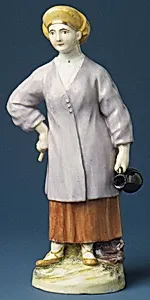
Medium
Hard-paste porcelain
Dimensions
Height: 8 1/4 in. (21 cm)
Classification
Ceramics-Porcelain
Culture
Russian, St. Petersburg
Department
European Sculpture and Decorative Arts
Museum
Metropolitan Museum of Art, New York, NY
Credit
The Jack and Belle Linsky Collection, 1982
Accession Number
1982.60.152
Rights
Public Domain
Tags
Art Historical Context
This delicate hard-paste porcelain figurine *Peasant Woman from Ing (Ingermanland)*, crafted by the renowned Imperial Porcelain Manufactory in St. Petersburg around 1780–1800, stands just 8¼ inches tall. Produced during the height of Catherine the Great's reign and into the early years of Alexander I, it exemplifies the factory's mastery of this technically demanding medium. Hard-paste porcelain, at high temperatures for exceptional durability and translucency, allowed Russian artisans to rival Europe's finest like Meissen and Sèvres, blending technical precision with artistic flair. The figure captures a woman from Ingria—a historic region southwest of St. Petersburg, home to Finnish-Ingrían peoples under Russian imperial rule. Such "costume figures" were popular in neoclassical decorative arts, romanticizing ethnic diversity and folk traditions amid Russia's expanding empire. Vibrantly glazed in traditional attire, she reflects the era's fascination with national identity and peasant life, serving as both a collector's delight and a window into cultural mosaics. Today, housed in the Metropolitan Museum of Art's European Sculpture and Decorative Arts department as part of The Jack and Belle Linsky Collection, this piece invites visitors to appreciate the porcelain's fine modeling and the manufactory's role in elevating Russian ceramics to imperial splendor.
About the Artist
Imperial Porcelain Manufactory, St. Petersburg · 1744–present
The Imperial Porcelain Manufactory in Saint Petersburg, founded in 1744 by Dmitry Ivanovich Vinogradov under the decree of Empress Elizabeth Petrovna, marked Russia's entry into porcelain production as the third such enterprise in Europe after Meissen and Vienna. Vinogradov, a mining engineer educated in Saxony, developed the nation's first hard-paste porcelain formula using local materials, drawi...