
Peasant Woman with Closed Eyes
1874
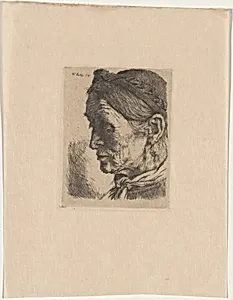
Medium
etching on Japanese paper
Dimensions
plate: 8.7 × 7 cm (3 7/16 × 2 3/4 in.) sheet: 17.8 × 13.2 cm (7 × 5 3/16 in.)
Classification
Department
CG-E
Museum
National Gallery of Art, Washington, D.C.
Credit
Gift of James A. Bergquist, Boston, in honor of Shelley R.Langdale
Accession Number
2020.149.23
Rights
Public Domain
Art Historical Context
Wilhelm Leibl's *Peasant Woman with Closed* (1874) is a poignant etching on Japanese paper, showcasing the German artist's mastery of intimate portraiture. Captured in a compact plate size of 8.7 × cm, the work depicts a serene rural figure with eyes softly shut, inviting viewers into a moment of quiet introspection. Leibl, a key figure in 19th-century German Realism, often turned to everyday peasant subjects, rendering them with unflinching honesty and emotional depth amid the era's growing interest in the working class. Etching, a precise intaglio technique involving acid-bitten lines on a metal plate, allowed Leibl to achieve subtle textures and tonal gradations, perfectly suited to the velvety absorbency of Japanese paper—a material prized by European printmakers for its durability and luminous quality. This choice reflects mid-19th-century artistic exchanges with Japanese aesthetics, blending Eastern refinement with Western precision. Housed in the National Gallery of Art's Prints department (gift of James A. Bergquist in honor of Shelley R. Langdale), this modest yet powerful sheet exemplifies Leibl's bridge between painting and printmaking, offering museum visitors a window into Realism's human-centered ethos.
About the Artist
Wilhelm Leibl · 1844–1900
Wilhelm Leibl (1844–1900) was the foremost German Realist painter of the nineteenth century, a figure who dedicated his career to an uncompromising fidelity to observed reality at a time when idealized academic painting still dominated official taste. Born in Cologne, he studied at the Munich Academy under Karl von Piloty, but the decisive influence on his development came from his encounter with ...