
Peasants
17th century
Medium
Pen and brown ink, brush and gray wash
Dimensions
sheet: 5 3/4 x 8 1/8 in. (14.6 x 20.6 cm)
Classification
Drawings
Department
Drawings and Prints
Museum
Metropolitan Museum of Art, New York, NY
Credit
Gift of Roys N. Brown, 1929
Accession Number
29.107
Rights
Public Domain
Tags
Art Historical Context
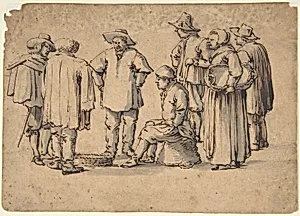
In the heart of the Dutch Golden Age Willem van de Velde (1611–1693), a master draftsman renowned for his marine scenes, captured everyday life with remarkable sensitivity in *Peasants*. Created in the 17th century, intimate drawing—measuring just 5 3/4 x 8 1/8 inches—showcases a group of men, likely rural laborers, rendered in pen and brown ink with subtle brush and gray wash. techniques were hallmarks of Dutch drawing practice, allowing artists to achieve depth, texture, and atmospheric nuance on a small scale, often as studies for larger paintings or standalone works. Van de Velde's skill shines in the fluid lines and tonal washes that evoke the grit and camaraderie of peasant life, reflecting the era's growing fascination with ordinary folk amid Holland's prosperity from trade and art patronage. Though best known for ships at sea, his genre scenes like this highlight his versatility and eye for human detail. Housed in the Metropolitan Museum of Art's Drawings and Prints department (gift of Roys N. Brown, 1929), *Peasants* invites us to appreciate the quiet dignity of the working class, a theme that humanized Dutch art during a time of cultural flourishing.
About the Artist
Willem van de Velde I · 1611–1693
**Willem van de Velde the Elder (1610/11–1693)** was a pioneering Dutch Golden Age marine artist renowned for his meticulous drawings and pen paintings of ships and naval engagements. Born in Leiden to a Flemish skipper, he grew up immersed in maritime life, joining his father at sea from an early age. He married Judith Adriaens van Leeuwen in 1631, and their children included Magdalena, the marin...