
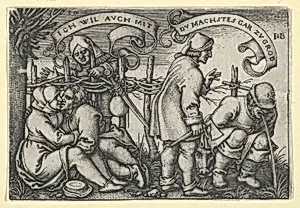
Peasants Behind the Hedge from "The Peasants' Feast" or "The Twelve Months"
1546–47
Medium
Engraving; second state of two (Pauli)
Dimensions
sheet: 1 15/16 x 2 7/8 in. (5 x 7.3 cm)
Classification
Prints
Department
Drawings and Prints
Museum
Metropolitan Museum of Art, New York, NY
Credit
The Elisha Whittelsey Collection, The Elisha Whittelsey Fund, 1966
Accession Number
66.529.57
Rights
Public Domain
Tags
Art Historical Context
Sebald Beham, a leading figure among the German "Little Masters" of the Northern Renaissance, created *Peasants Behind the* around 1546–47 as part of his series *The Peasants' Feast* ( known as *The Twelve*). These small engravings vividly capture rural life in 16th-century Germany, with a mix of earthy realism and subtle social commentary. Beham, based in Nuremberg, specialized in intricate genre scenes that elevated everyday peasant activities to fine art, reflecting the era's growing interest in secular subjects amid the Reformation's cultural shifts. This second-state engraving (per Pauli cataloguing) measures just under 2 by 3 inches, showcasing Beham's mastery of the intaglio technique. He incised fine lines into a copper plate, allowing for exceptional detail in clothing textures, facial expressions, and foliage—even in this miniature format. The scene peeks at figures behind a hedge, including men and women with swords, hinting at rowdy festivities or mock combat typical of peasant gatherings, blending humor with the era's rustic vitality. Housed in the Metropolitan Museum of Art's Drawings and Prints department (Elisha Whittelsey Collection, 1966), this print exemplifies the Little Masters' innovation in printmaking, making high art accessible through affordable multiples. It invites viewers to ponder the joys and chaos of common folk life, preserved in exquisite precision.
About the Artist
Sebald Beham · 1500–1550
Sebald Beham (1500–1550), a pioneering German printmaker and painter born in Nuremberg, emerged as one of the most prolific artists of the Northern Renaissance. The elder brother of fellow artist Barthel Beham, he grew up in a milieu steeped in artistic tradition, though details of his early training remain sparsely documented. Recorded as a journeyman painter (Malergeselle) by 1521 and a master w...