
Pêche au Vif
1864
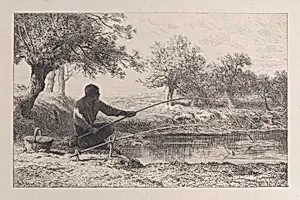
Medium
Etching
Dimensions
Sheet: 13 in. × 18 7/8 in. (33 × 48 cm) Plate: 5 7/8 × 8 1/4 in. (15 × 21 cm)
Classification
Prints
Department
Drawings and Prints
Museum
Metropolitan Museum of Art, New York, NY
Credit
Harris Brisbane Dick Fund, 1927
Accession Number
27.10.36
Rights
Public Domain
Tags
Art Historical Context
**Pêche au Vif** (1864) by Charles Jacque captures a serene moment of rural life, depicting men engaged in fishing—likely with live bait, as suggested by the title's French phrasing. Jacque, a 19th-century French artist was renowned for his intimate portrayals of peasants and the countryside, evoking the everyday rhythms of the French provinces during the Second Empire era. This etching, now housed in the Metropolitan Museum Art's Drawings and Prints, reflects the period's fascination with authentic, unidealized scenes of labor and nature. Printed from a modest plate measuring 5⅞ × 8¼ inches, the work exemplifies etching's precision: Jacque incised fine lines into a metal plate, inking the grooves to transfer intricate details onto paper. This intaglio technique allowed for rich tonal contrasts and textures, making prints an accessible medium for sharing artistic visions beyond oil paintings. The larger sheet size (13 × 18⅞ inches) provided space for generous margins, a hallmark of fine 19th-century printmaking. Acquired through the Harris Brisbane Dick Fund in 1927, *Pêche au Vif* offers visitors a window into 1860s rural France, where fishing was both sustenance and pastime. Its subtle charm invites contemplation of how simple activities connected people to their environment, a timeless theme in European print traditions.
About the Artist
Charles Jacque · 1813–1894
Charles-Émile Jacque (1813–1894) was a pioneering French painter, engraver, and illustrator whose career bridged the worlds of printmaking and pastoral painting. Born in Paris amid a difficult childhood, he apprenticed at age seventeen to a map engraver, mastering drypoint technique and producing his first etching in 1830—a copy of a head after Rembrandt. After serving seven years in the French Ar...