
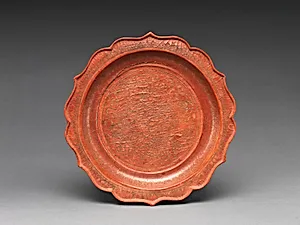
宋末元初 紅漆戧金菱花口高足盤|Pedestaled dish with scalloped rim
Unknown Artist
13th century
Medium
Red and black lacquer with engraved gold decoration (qiangjin)
Dimensions
H. 2 in. (5.1 cm); Diam. 9 in. (22.9 cm)
Classification
Lacquer
Culture & Period
China · Song (960–1279–Yuan (1271–1368) dynasty
Department
Asian Art
Museum
Metropolitan Museum of Art, New York, NY
Credit
Gift of Florence and Herbert Irving, 2015
Accession Number
2015.500.1.51
Rights
Public Domain
Art Historical Context
This exquisite pedestaled dish with a scalloped rim, crafted the late Song to early Yuan dynasty (13th century), exemplifies the pinnacle of Chinesequer artistry. Standing just 2 inches high and 9 inches in diameter, its delicate form—elevated on a slender foot with a lobed, diamond-shaped mouth—was designed for elite dining or ceremonial display, reflecting the refined aesthetics of imperial courts during a time of cultural transition. The dish's medium, red and black lacquer adorned with qiangjin (engraved gold decoration), showcases a sophisticated technique perfected in China. Artisans applied layers of lacquer, then incised intricate patterns into the surface and hammered fine gold wires into the grooves for a shimmering effect. This labor-intensive process, demanding immense skill and patience, elevated lacquerware from utilitarian objects to treasures symbolizing wealth and status. Spanning the Song (960–1279) and Yuan (1271–1368) dynasties, this piece captures a pivotal era: the Song's scholarly elegance yielding to the Yuan's Mongol-influenced dynamism. Now at the Metropolitan Museum of Art through the generosity of Florence and Herbert Irving (2015), it invites us to marvel at ancient China's mastery of materials and form.