
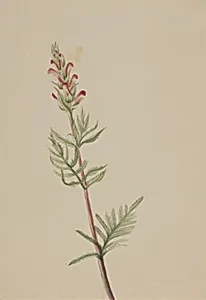
Pedicularis bracteosa
ca. 1917-1918
Medium
Painting
Classification
Painting
Department
Smithsonian Collection
Museum
Smithsonian American Art Museum
Credit
Smithsonian American Art Museum, Gift of the artist
Accession Number
1970.355.72
Rights
Public Domain
Tags
Art Historical Context
Mary Vaux Walcott'sPedicularis bracte*, created around 1917-1918, captures the beauty of this wildflower, known as bracted lousewort, native to the mountainous regions of western North America. Walcott a pioneering Quaker artist, mountaineer, amateur botanist, produced over a thousand meticulously detailed watercolor paintings of North American flora her expeditions in the Canadian Rockies and beyond. Gifted by the artist herself to the Smithsonian American Art Museum, painting exemplifies her lifelong dedication to documenting vanishing wildflowers through art. Rendered in watercolor—a medium ideal for botanical illustration due to its transparency and precision—Walcott's work blends scientific accuracy with artistic elegance. Each petal, stem, and leaf is rendered with lifelike detail, reflecting her collaboration with botanists like her husband, Charles Doolittle Walcott, a Smithsonian secretary. During World War I, amid global upheaval, her serene depictions offered a timeless celebration of nature's resilience. This piece, part of the Smithsonian's esteemed collection, highlights the intersection of art and science in early 20th-century America, preserving biodiversity for future generations. Visitors will appreciate its quiet precision, inviting a closer look at nature's intricate designs.