
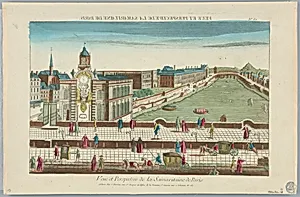
Peep-show, Veue et Perspective de la Samaritaine de Paris, No. 62
ca. 1750
Medium
Classification
Department
Smithsonian Collection
Museum
Smithsonian American Art Museum
Credit
Gift of Mrs. Edward R. Wharton
Accession Number
1901-30-13
Rights
Public Domain
About this artwork
Research in Progress
Art Historical Context
Step into 18th-century Paris with *Peep-show, Vue et Perspective de la Samaraine de Paris, No 62*, a captivating print from around 1750. This artwork depicts the Fontaine de la Samaritaine a grand Renaissance-era pump and architectural marvel on the Pont Neuf bridge over the Seine. Built in 1604 by King Henry IV, it served as both a water fountain and a symbolic clock tower adorned with biblical scenes from the Good Samaritan story, blending utility with ornate decoration. By the mid-1700s, it stood as an iconic landmark in a bustling city undergoing Enlightenment-era transformations. As a specialized "peep-show" or *vue d'optique* print, this piece was designed for viewing through a peephole device with magnifying lenses, creating a thrilling illusion of depth and three-dimensionality. Such prints were a popular optical entertainment in Europe, merging artistry with early science to immerse viewers in distant scenes. Printed anonymously, it exemplifies the era's fascination with perspective and urban spectacle, capturing Paris's vibrant street life before the fountain's demolition in 1813. Today, housed in the Smithsonian American Art Museum as a gift from Mrs. Edward R. Wharton, this rare survivor invites us to ponder vanishing wonders of old Europe. Research continues to uncover its full story, but it remains a window into 18th-century visual culture and ingenuity. (198 words)
About the Artist
Unknown
The artist designated as "Unknown" in our virtual museum's collection exemplifies a poignant chapter in art history: creators whose identities have faded into obscurity despite the enduring power of their work. With only one known artwork attributed to them in our holdings, this figure represents countless anonymous hands that shaped visual culture across centuries. Museums worldwide, including th...