
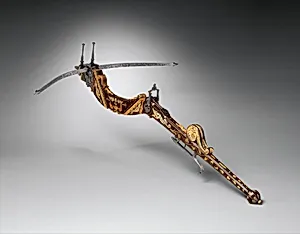
Pellet and Bolt Crossbow
Unknown Artist
dated 1573
Medium
Steel, wood (cherry, mahogany), staghorn, ivory (probably elephant)
Dimensions
L. 37 3/4 in. (95.9 cm); W. 25 5/16 in. (64.3 cm); Wt. 4 lb. 6 oz. (1,977 g)
Classification
Archery Equipment-Crossbows
Culture
Northern Italian or French, probably Savoy
Department
Arms and Armor
Museum
Metropolitan Museum of Art, New York, NY
Credit
Gift of William H. Riggs, 1913
Accession Number
14.25.1583
Rights
Public Domain
Art Historical Context
Step into the world of Renaissance weaponry with the *Pellet and Bolt Cross*, a masterful 1573 creation likely from Northern Italy or France, possibly the Savoy region This versatile piece, classified as archery equipment, could fire both bolts (short arrows) and pellets (lead balls), making it ideal for hunting or battlefield use. Measuring 37 3/4 inches long weighing just over 4 pounds, its compact design balanced portability with power, reflecting the era's innovative arms engineering. Crafted from steel for the bow and mechanism, cherry and mahogany woods for the stock, plus staghorn and probable elephant ivory accents, the crossbow showcases exquisite Renaissance craftsmanship. These luxury materials—exotic woods imported for durability and beauty, ivory and staghorn for ergonomic grips and decorative inlays—elevated it beyond mere utility into a status symbol for nobility. The intricate joinery and metalworking highlight the gunsmith's artistry, blending function with aesthetic finesse typical of Savoyard armories. Housed in the Metropolitan Museum of Art's Arms and Armor Department (gift of William H. Riggs, 1913), this crossbow offers a window into 16th-century Europe's martial culture, where technological advancement met opulent design. It reminds us how arms were both tools of war and treasures of connoisseurship.