
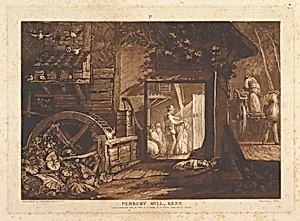
Pembury Mill, Kent (Liber Studiorum, part III, plate 12)
June 10, 1808
Medium
Etching and mezzotint; second state of four (Finberg)
Dimensions
plate: 7 3/16 x 10 1/2 in. (18.3 x 26.7 cm) sheet: 7 1/8 x 11 1/2 in. (18.1 x 29.2 cm)
Classification
Prints
Department
Drawings and Prints
Museum
Metropolitan Museum of Art, New York, NY
Credit
The Elisha Whittelsey Collection, The Elisha Whittelsey Fund, 1950
Accession Number
50.521.12
Rights
Public Domain
Tags
Art Historical Context
**Pembury Mill,** is a captivating print from J.M.W. Turner's *Liber Studiorum*, ambitious series of landscape etchings launched in 1807 to showcase his mastery of varied terrains and moods. Designed by the Romantic visionary Joseph Mallord William Turner and engraved by Charles Turner, this plate from Part III (dated June , 1808) captures a serene English countryside scene at Pembury Mill in Kent. of men and horse-drawn carriages animate the watermill's rustic setting, evoking the everyday harmony of rural life amid flowing water and lush surroundings. Printed in etching and mezzotint—the second state of four, as cataloged by Finberg—this work highlights the mezzotint's velvety tonal range, ideal for Turner's luminous skies and subtle gradations of light. Mezzotint, a "dark manner" technique starting from a textured black ground and scraping to reveal highlights, allowed unprecedented atmospheric depth in prints, rivaling paintings. Part of Turner's effort to democratize his art through affordable folios, *Liber Studiorum* influenced generations of printmakers and celebrated Britain's evolving landscape during the Industrial Age. Housed in the Metropolitan Museum of Art's Elisha Whittelsey Collection, this 7 3/16 x 10 1/2-inch plate invites visitors to ponder Turner's blend of observation and imagination, bridging 18th-century topographical tradition with Romantic sublime.