
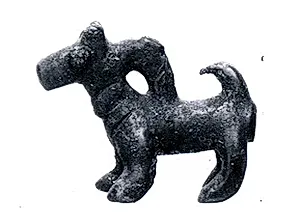
Pendant in the form of a dog
Unknown Artist
ca. 8th–7th century BCE
Medium
Bronze
Dimensions
0.87 x 1.14 in. (2.21 x 2.9 cm)
Classification
Metalwork-Ornaments
Culture & Period
Iran · Iron Age III
Department
Ancient Near Eastern Art
Museum
Metropolitan Museum of Art, New York, NY
Credit
Rogers Fund, 1943
Accession Number
43.102.15
Rights
Public Domain
Tags
Art Historical Context
This delicate bronze pendant, shaped like a dog, dates to Iran's Iron Age III period (ca. 8th–7th BCE). Crafted as a small ornament—measuring just 0.87 x 1.14 inches—it likely served as jewelry or an amulet, worn close to the body for personal adornment or protection. Ancient Near Eastern metalworkers excelled in bronze casting, enabling intricate details on such tiny scales, reflecting advanced technical skill during a time when iron tools were emerging alongside traditional bronze techniques. Dogs held symbolic importance in ancient Iranian culture, often associated with loyalty, guardianship, and the hunt, appearing in art as faithful companions or protective spirits. This piece exemplifies the era's zoomorphic jewelry, blending everyday functionality with spiritual resonance. Acquired through the Rogers Fund in 1943, it now graces the Metropolitan Museum of Art's Ancient Near Eastern Art collection, offering a window into the daily lives and beliefs of Iron Age peoples. (178 words)