
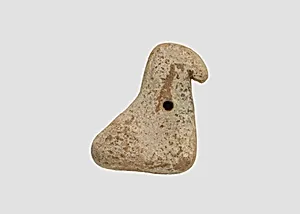
Pendant in the form of a duck
Unknown Artist
ca. 9th century BCE
Medium
Faience, glaze
Dimensions
1.26 x 0.94 in. (3.2 x 2.39 cm)
Classification
Faience-Ornaments
Culture & Period
Iran · Iron Age II, Hasanlu Period IV
Department
Ancient Near Eastern Art
Museum
Metropolitan Museum of Art, New York, NY
Credit
Purchase, Mrs. Constantine Sidamon-Eristoff Gift, 1961
Accession Number
61.100.94
Rights
Public Domain
Tags
Art Historical Context
This delicate pendant, shaped like a duck, hails from ancient Iran during the Iron Age, specifically the Hasanlu IV around the 9th century. Crafted from faience—a composite material of crushed quartz or sand glazed to mimic semiprecious stones—it measures just 1.26 x 0.94 inches, perfect for personal adornment as jewelry or an amulet. Discovered in the context of the Hasanlu archaeological site, it reflects the sophisticated craftsmanship of a vibrant ancient Near Eastern culture. Faience's vibrant glaze not only provided durability and a jewel-like sheen but also allowed for intricate modeling of naturalistic forms like this duck, a common motif in regional art symbolizing perhaps everyday life or protective symbolism. The pendant's small scale highlights the technical skill required to fire such tiny objects without distortion, showcasing advanced glazing techniques that preserved color and detail over millennia. Today, housed in the Metropolitan Museum of Art's Ancient Near Eastern Art department, this unassuming ornament offers a window into the daily lives and artistic ingenuity of Iron Age Iranians, reminding us how even miniature works carried profound cultural weight.