
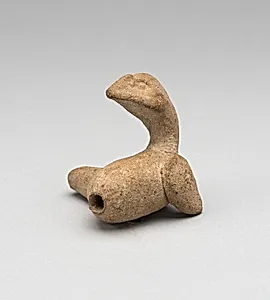
Whistle in the Shape of a Bird
c. 800 CE
Medium
Earthenware
Dimensions
5.4 × 4.6 × 4.6 cm (2 3/16 × 1 13/16 × 1 13/16 in.)
Classification
musical instrument
Department
Arts of the Americas
Museum
Art Institute of Chicago
Accession Number
120421
Rights
Public Domain
Art Historical Context
Nestled in the Arts of the Americas collection at the Art Institute of Chicago, this charming *Whistle in the Shape of a Bird* hails from Veracruz during the Classic period, around 800 CE. Crafted from earthenware, it measures a petite 5.4 × 4.6 × 4.6 cm, fitting perfectly in the palm of your hand. Its whimsical bird form exemplifies the Veracruz culture's mastery of ceramic modeling, where everyday objects doubled as functional art—here, a musical instrument that likely produced a distinctive trill when blown. In ancient Mesoamerica, Veracruz artisans from Mexico's Gulf Coast region were renowned for their vibrant ceramic traditions during the Classic era (c. 250–900 CE). These zoomorphic whistles, often depicting birds, animals, or humans, served ritualistic purposes, perhaps in ceremonies honoring deities or invoking natural spirits. The earthenware medium allowed for intricate hand-building and firing techniques, creating durable yet delicate pieces that blended sculpture with sound. This tiny treasure offers a window into pre-Columbian life, where art was alive with utility and symbolism. Imagine the soft whistle echoing in a rainforest ritual— a testament to Veracruz's innovative fusion of form, function, and cultural reverence.