
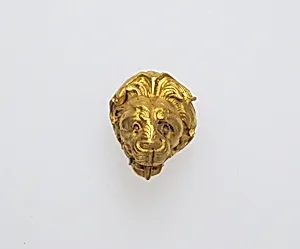
Pendant in the form of a lion's head
Unknown Artist
Medium
Gold
Dimensions
Other (head): 7/8 × 3/4 × 3/4 in. (2.2 × 2 × 1.9 cm) Diameter (neck): 5/8 × 9/16 in. (1.6 × 1.4 cm)
Classification
Gold and Silver
Department
Greek and Roman Art
Museum
Metropolitan Museum of Art, New York, NY
Credit
Rogers Fund, 1914
Accession Number
13.234.3
Rights
Public Domain
Tags
Art Historical Context
This exquisite gold pendant, shaped as a fierce lion's head, hails from the ancient Greek and Roman world, as housed in The Metropolitan Museum of Art's Greek and Roman Art department Crafted from pure gold, it measures a delicate 7/8 × 3/4 × 3/4 inches for the head and features a neck loop of 5/8 × 9/16 inches, perfect for wearing as jewelry. Acquired through the Rogers Fund in 4, it exemplifies the fine metalwork of antiquity, where such small-scale objects demanded masterful precision. Lions held profound symbolic power in Greek and Roman culture, representing strength, courage, and divine protection—often linked to heroes like Heracles or gods such as Cybele. Worn as pendants, these amulets likely served both decorative and apotropaic purposes, warding off evil while signaling the wearer's status. Gold, a precious and enduring medium, was reserved for elite adornments, its luster evoking the sun's radiance and immortality. Though the artist and exact date remain unknown, the pendant's intricate modeling of the lion's mane, eyes, and snarling mouth showcases advanced granulation or repoussé techniques typical of Mediterranean goldsmiths. A captivating glimpse into ancient lives, it invites us to imagine it dangling from a noble's neck over two millennia ago.