
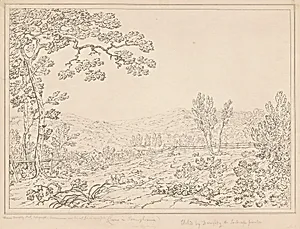
Pennsylvania Landscape
c. 1810-1830
Medium
etching in black on wove paper
Dimensions
image: 25.72 × 35.72 cm (10 1/8 × 14 1/16 in.) sheet: 28.58 × 37.47 cm (11 1/4 × 14 3/4 in.)
Classification
Department
CG-W
Museum
National Gallery of Art, Washington, D.C.
Credit
Corcoran Collection (Museum Purchase, Mary E. Maxwell Fund)
Accession Number
2015.19.872
Rights
Public Domain
Art Historical Context
Thomas Doughty's *Pennsylvania Landscape*, created around 1810-1830, captures the serene beauty of America's early 19th-century wilderness through the delicate medium of etching on wove paper. Measuring about 10 by 14 inches, this-line print exemplifies Doughty's pioneering role as of the first native-born.S. artists to focus exclusively on landscape painting. His works, often romanticized visions of nature, bridged European traditions with a growing American appreciation for the nation's own vistas, predating the Hudson River School. Etching, Doughty's chosen technique here, involved incising lines into a metal plate with acid, allowing for intricate details in foliage, hills, and skies that evoke tranquility and grandeur. Printed on smooth wove paper, it reflects advancements in papermaking that made high-quality prints more accessible to a wider audience. As part of the Corcoran Collection at the National Gallery of Art, this piece highlights the era's cultural shift toward celebrating domestic scenery amid westward expansion. Doughty's landscapes not only showcased technical virtuosity but also fostered national pride, inviting viewers to ponder the sublime power of untouched American terrain. A quiet gem for print enthusiasts, it reminds us how early artists like him laid the foundation for America's artistic identity.
About the Artist
Thomas Doughty · 1793–1856
Comment on works: Landscapes