
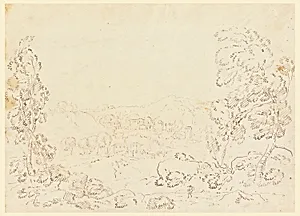
View of a Village in Mountainous Country
Medium
landscapes
Classification
landscapes
Department
Smithsonian Collection
Museum
Smithsonian American Art Museum
Credit
Museum purchase through gift of various donors
Accession Number
1901-39-333
Rights
Public Domain
About this artwork
Research in Progress
Art Historical Context
Carlo Marchionni's *View of a Village in Mountainous Country*, created between 1770 and 1786, captures the rugged beauty of an Italianate landscape during the late 18th century. As an Italian artist active from 1702 to 1786, Marchionni bridges the ornate Baroque and emerging Neoclassical styles, often blending architectural precision with natural scenery. This work, classified as a landscape and now housed in the Smithsonian American Art Museum's collection through a generous museum purchase, invites viewers to ponder the harmony between human settlements and dramatic terrain. Landscapes like this one reflect the era's growing fascination with the sublime—towering mountains evoking awe and the picturesque charm of nestled villages. Though research on this piece is ongoing, its medium highlights the technical mastery of oil or similar techniques favored for atmospheric depth and luminous skies. Marchionni's vision likely draws from Italy's Apennine or Alpine inspirations, offering a serene escape that resonated with Enlightenment-era tastes for nature's grandeur. For visitors, this painting serves as a window into 18th-century wanderlust, reminding us how artists like Marchionni elevated everyday vistas into timeless meditations on place and perspective. (198 words)