
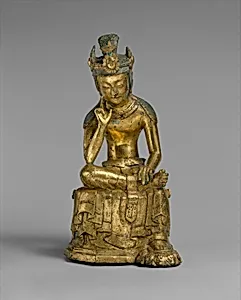
금동반가사유상 삼국|金銅半跏思惟像 三國|Pensive bodhisattva
Unknown Artist
mid-7th century
Medium
Gilt bronze
Dimensions
H. 8 7/8 in. (22.5 cm); W. 4 in. (10.2 cm); D. 4 1/4 in. (10.8 cm)
Classification
Sculpture
Culture & Period
Korea · Three Kingdoms period (57 B.C.–A.D. 676)
Department
Asian Art
Museum
Metropolitan Museum of Art, New York, NY
Credit
Purchase, Walter and Leonore Annenberg and The Annenberg Foundation Gift, 2003
Accession Number
2003.222
Rights
Public Domain
Tags
About this artwork
This sculpture titled "금동반가사유상 삼국|金銅半跏思惟像 三國|Pensive bodhisattva" dates to mid-7th century. Executed in gilt bronze, this work represents Korea, Three Kingdoms period (57 B.C.–A.D. 676) artistic traditions. The piece demonstrates the technical skill and artistic vision characteristic of its period. The work's presence in a major museum collection attests to its significance in the broader narrative of art history. As part of institutional holdings, it serves both scholarly research and public ed...
Art Historical Context
Nestled in the Metropolitan Museum of Art's Asian Art collection, this exquisite gilt bronze *Pensive Bodhisattva from Korea's Three Kingdoms period ( B.C.–A.D. 676) dates to the mid-7th century. Standing just 8⅞ inches tall, the sculpture captures a bodhisattva in the iconic half-lotus contemplative pose—known in Korean as *banjjasang*—with one leg elegantly draped over the other and a hand resting thoughtfully on the knee. Crafted by an unknown artist, its compact dimensions (H. 8⅞ in.; W. 4 in.; D. 4¼ in.) suggest it was likely a devotional object for personal altars or portable worship, embodying the spiritual depth of Buddhist practice during this era. Gilt bronze, a technique involving mercury gilding over cast bronze, lent these figures a radiant, divine glow, symbolizing enlightenment and the preciousness of Buddhist teachings. Introduced to Korea centuries earlier, Buddhism flourished in the Three Kingdoms—Baekje, Silla, and Goguryeo—fostering sophisticated metalworking traditions that blended indigenous craftsmanship with continental influences from China and India. This piece exemplifies the period's artistic prowess, with its serene expression and fluid drapery highlighting a uniquely Korean sensitivity to introspection and compassion. Acquired through the generous Walter and Leonore Annenberg gift in 2003, the sculpture invites visitors to ponder the bodhisattva's meditative gaze, a timeless emblem of inner peace amid the turbulent kingdoms. It bridges ancient devotion and modern appreciation, revealing how art illuminated spiritual life in early Korea.