
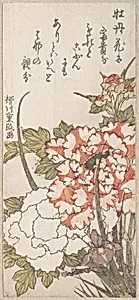
Peonies and Iris
18th–19th century
Medium
Woodblock print (surimono); ink and color on paper
Dimensions
8 1/16 x 3 5/8 in. (20.5 x 9.2 cm)
Classification
Prints
Culture
Japan
Department
Asian Art
Museum
Metropolitan Museum of Art, New York, NY
Credit
H. O. Havemeyer Collection, Bequest of Mrs. H. O. Havemeyer, 1929
Accession Number
JP2176
Rights
Public Domain
Tags
Art Historical Context
**Peonies and Iris** is a delicate woodblock print (surono) by the Japanese artist Yanagawa Shigemasa, in the late 18th to early 19th century This intimate work, measuring just 8 1/16 x 3 5/8 inches, blooming peonies and irises in vibrant inks and colors on paper. Shigemasa, a of the ukiyo-e tradition, specialized in these luxurious, privately commissioned prints, often produced for elite poetry circles or New Year's celebrations. Surimono like this one stand out for their refined techniques: intricate carving for fine details, subtle color gradations (bokashi), and sometimes embossing or metallic pigments for a tactile, jewel-like quality. Peonies, symbols of wealth and honor in Japanese culture, pair beautifully with irises, evoking themes of valor and seasonal renewal—perfect for poetic reflection. Part of the Metropolitan Museum of Art's H. O. Havemeyer Collection, this print exemplifies the golden age of Japanese printmaking, bridging art and elite social life. Visitors will appreciate its compact elegance, a window into Edo-period Japan's love for nature's fleeting beauty.