
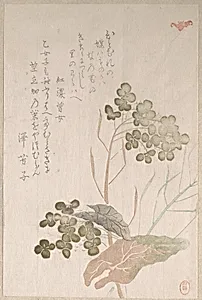
Natane Flower
19th century
Medium
Part of an album of woodblock prints (surimono); ink and color on paper
Dimensions
8 3/8 x 5 1/2 in. (21.3 x 14 cm)
Classification
Prints
Culture & Period
Japan · Edo period (1615–1868)
Department
Asian Art
Museum
Metropolitan Museum of Art, New York, NY
Credit
H. O. Havemeyer Collection, Bequest of Mrs. H. O. Havemeyer, 1929
Accession Number
JP2258
Rights
Public Domain
Tags
Art Historical Context
Nestled within an exquisite album of woodblock prints, *Natane Flower* captures the ephemeral beauty of blooming rapeseed flowers and their lush leaves, rendered in vibrant ink and color on paper. Created by an unidentified artist during Japan's Edo period (1615–8), specifically in the 19th, this intimate print measures just 8 3/8 x 5 1/2 inches, close contemplation. As a *surimono*—a luxurious, privately commissioned woodblock print often produced for New Year's greetings or poetic gatherings—it exemplifies the refined artistry of ukiyo-e traditions, blending technical precision with seasonal elegance. Surimono like this one were elite connoisseur's items, distinct from mass-produced prints due to their high-quality pigments, subtle embossing, and mica accents that enhance texture and shimmer. In Edo-era Japan, flowers such as natane symbolized spring renewal and the fleeting nature of life, resonating with wabi-sabi aesthetics. The meticulous carving and multi-block printing process allowed for rich color layering, showcasing the woodblock medium's versatility. Today, *Natane Flower* graces the Metropolitan Museum of Art's Asian Art Department, part of the renowned H. O. Havemeyer Collection bequeathed in 1929. This piece offers visitors a window into Japan's vibrant print culture, where nature's poetry met masterful craftsmanship.