
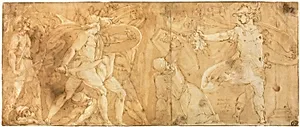
Perseus with the Head of Medusa, Turning Phineus and his Followers to Stone
Medium
Pen and brown ink, with brush and brown wash, over black chalk, on ivory laid paper
Dimensions
20.4 × 48.7 cm (8 1/16 × 19 3/16 in.)
Classification
ink with wash
Department
Prints and Drawings
Museum
Art Institute of Chicago
Accession Number
42454
Rights
Public Domain
Art Historical Context
Behold *Perseus with the Head of Medusa, Turning Phineus and his Followers to Stone* (1567), a dynamic drawing by Polidoro da Caravaggio, now treasured in the Art Institute of Chicago's Prints and Drawings Department. This vivid scene captures a pivotal moment from Ovid's *Metamorphoses*: the hero Perseus, victorious after slaying the Gorgon Medusa, wields her petrifying head to transform his rival Phineus and followers into stone during the wedding feast for Andromeda. Polidoro, a key Mannerist artist trained under Raphael in Rome, infuses the composition with dramatic tension and elongated figures characteristic of the style's expressive distortion and emotional intensity. Executed in pen and brown ink with brush and brown wash over black chalk on ivory laid paper (20.4 × 48.7 cm), the work showcases Renaissance draftsmanship at its finest. The layered technique—starting with chalk underdrawing, refined by precise ink lines and atmospheric wash—creates depth, shadow, and a sense of chaotic movement among the writhing figures. Such preparatory-style drawings were vital in 16th-century workshops, bridging sketch to finished painting and highlighting artists' virtuosity. This piece reflects Mannerism's fascination with classical mythology and moral drama, bridging High Renaissance harmony with emerging Baroque energy. A rare survival from Polidoro's circle post-1543, it offers visitors a window into the inventive minds shaping Europe's artistic golden age.
About the Artist
Polidoro da Caravaggio · 1492–present
Polidoro Caldara, known as Polidoro da Caravaggio, was born around 1499 in Caravaggio, Lombardy, and emerged as one of the most innovative painters of the early Mannerist period. Arriving in Rome circa 1515 as an untrained laborer hauling plaster for the Vatican Logge decorations, he quickly caught the eye of Raphael's key assistant, Maturino da Firenze. By 1517, Polidoro had joined Raphael's work...