
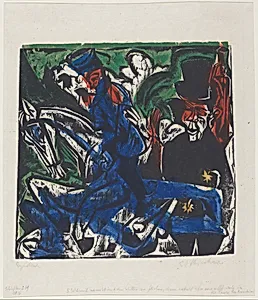
Peter Schlemihls wundersame Geschichte: Begegnung Schlemihls mit dem grauen Männlein auf der Landstrasse (Peter Schlemihl's Wondrous Story: Schlemihl Encounters the Little Gray Man on the Road)
Medium
color woodcut on wove paper
Dimensions
block: 29.9 x 29.7 cm (11 3/4 x 11 11/16 in.) overall: 41.3 x 35.4 cm (16 1/4 x 13 15/16 in.)
Classification
Department
CG-W
Museum
National Gallery of Art, Washington, D.C.
Credit
New Century Fund and Gift of Ruth and Jacob Kainen
Accession Number
1999.68.6
Rights
Public Domain
Art Historical Context
Ernst Ludwig Kirchner, a figure in the German Expressionist group Die Brücke, created vivid color woodcut in 1915, amid the turmoil of World War I. print illustrates a pivotal scene from Adelbert von Chamisso 1814 novella *Peter Schlemils wundersame Geschichte*, where protagonist encounters a mysterious gray man on a country road—foreshadowing his fateful deal to sell his shadow. Kirchner's choice of subject reflects his fascination with folklore, alienation, and the human psyche, themes central to Expressionism's raw emotional intensity. Rendered on wove paper, the work showcases Kirchner's mastery of color woodcut, a demanding technique involving multiple carved blocks for layering vibrant hues like fiery reds, deep blues, and stark contrasts. At 29.9 x 29.7 cm, its compact square format amplifies the dramatic tension through jagged lines and distorted figures, evoking unease and otherworldliness. This medium was revolutionary for Kirchner, pushing beyond traditional black-and-white woodcuts to rival painting's expressiveness. Housed in the National Gallery of Art, thanks to the New Century Fund and Ruth and Jacob Kainen, this print highlights Kirchner's innovative printmaking during a period of personal crisis, including his discharge from military service. It invites visitors to ponder themes of loss and identity, bridging Romantic literature with modernist angst.
About the Artist
Ernst Ludwig Kirchner · 1880–1938
Ernst Ludwig Kirchner was born on May 6, 1880, in Aschaffenburg, Germany, to parents Ernst and Maria Kirchner, part of a family of Prussian descent that frequently relocated due to his father's career as a chemical technician. After early schooling in various towns, he studied architecture at the Königliche Technische Hochschule (Technical University) in Dresden from 1901 to 1905, taking courses i...