
Petite Meute de Chiens
1757
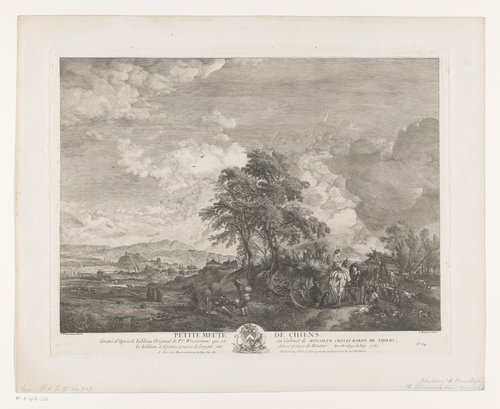
Medium
etching
Dimensions
371; 482
Rights
Public Domain
About this artwork
Maakt deel uit van een serie van 89 prenten te dateren tussen ca. 1733-1762, naar het geschilderde oeuvre van Philips Wouwerman.
Art Historical Context
"Petite Meute deens" (Little Pack of Dogs), an etching by French engraver Jean Moyreau from 1757, captures lively energy of a small group of hunting hounds in exquisite detail. Measuring 371 mm high by 482 mm wide, this print exemplifies the precision of 18th-century etching techniques, where acid etches fine lines into a metal plate, allowing for intricate textures like the dogs' glossy fur and alert expressions. Moyreau's work transports viewers into a dynamic moment, likely evoking the thrill of the hunt. This piece forms part of an ambitious series of 89 prints, produced between approximately 1733 and 1762, faithfully reproducing the painted oeuvre of Philips Wouwerman, a leading Dutch Golden Age artist (1618–1668). Wouwerman specialized in Baroque landscapes teeming with equestrian scenes, hunts, and military encampments, blending meticulous realism with atmospheric drama. Moyreau's etchings preserved and popularized these compositions for a broader audience. Etchings like this one were vital in the Rococo era, democratizing access to 17th-century masterpieces amid growing connoisseurship. They highlight Wouwerman's enduring appeal—his works adorned elite collections—and showcase engraving's role in art dissemination, bridging Dutch mastery with French elegance. A charming window into hunting culture and artistic legacy!
About the Artist
Jean Moyreau · 1690–1762
**Jean Moyreau (1690–1762)** was a French engraver renowned for his reproductive prints that faithfully translated the dynamic compositions of Dutch and French masters into the medium of copperplate. Born in Orléans, he spent his career in Paris during the height of the Rococo period, focusing on the precise art of etching and engraving to capture atmospheric effects, textures, and lively scenes. ...