
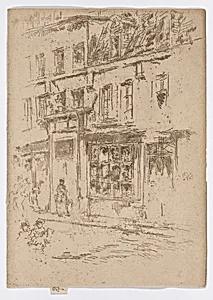
Petite Rue au Beurre, Brussels
Classification
Department
Smithsonian Collection
Museum
Smithsonian American Art Museum
Credit
Gift of Charles Lang Freer
Accession Number
F1888.19
Rights
Public Domain
Tags
About this artwork
During a visit to Brussels in September 1887, Whistler sought out appealing subjects in the working-class quarters of Les Marolles, a historic district dating back to the Middle Ages. The shops Whistler etched on Little Butter Street are built against the south walls of the church of St. Nicholas. By cropping out the church, which towers above the buildings in the scene, Whistler aligned this rare image, one of only three recorded, with other close-up shop fronts he encountered in Britain, Franc...
Art Historical Context
In 1887, during a trip to Brussels, American artist James McNeill Whistler ventured into the gritty, historic working-class neighborhood of Les Marolles district rooted in the Middle Ages., on Petite Rue au Beurre ( Butter Street), he captured the modest shop fronts nestled against the south walls of the Church of St. Nicholas. This etching, one of only three known examples from his brief Belgian foray, reflects Whistler's fascination with everyday urban vignettes, akin to his close-up studies of storefronts in Britain and France. Whistler's masterful etching technique—using acid to bite intricate lines into a metal plate—brings alive the textured facades and bustling street life with subtle precision and atmospheric depth. By boldly cropping out the towering church above, he creates an intimate, flattened composition that emphasizes the poetry of the ordinary, aligning with his Aesthetic movement principles of "art for art's sake." This rare print highlights his skill in transforming humble architecture into evocative art. Today, *Petite Rue au Beurre* graces the Smithsonian American Art Museum, a gift from collector Charles Lang Freer, whose passion for Whistler's work helped preserve these gems for future generations.