
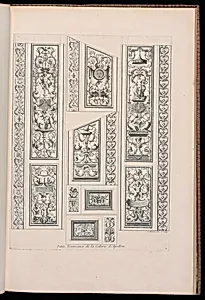
Petits Trumeaux de la Galerie d’Apollon
Medium
Bound print
Classification
Bound print
Department
Smithsonian Collection
Museum
Smithsonian American Art Museum
Credit
Purchased for the Museum by the Advisory Council
Accession Number
1921-6-222-4
Rights
Public Domain
About this artwork
Research in Progress
Art Historical Context
Step into the opulent world of early 18th-century French arts with *Petits Trumeaux la Galerie d’Apon*, a bound print created by Jean Bérain the Younger (1674–1726). This French artist, succeeding his father as designer to King Louis XIV, specialized in intricate ornamental motifs that bridged Baroque grandeur and emerging Rococo elegance. Produced in 1710, the work features designs for "small trumeaux"—decorative panels typically placed over doors or between windows in grand spaces like the lavish Galerie d’Apollon at the Louvre Palace, a symbol of royal splendor and Apollo's mythological patronage of the arts. As a bound print, this artwork represents a key medium for disseminating high-style designs across Europe. Engravings like these allowed architects, gilders, and cabinetmakers to replicate courtly elegance in palaces and chateaus, influencing the spread of French taste during the Regency era. Bérain’s precise line work, alive with scrolling foliage, mythical figures, and gilded flourishes, exemplifies the era’s love for harmonious symmetry and fantasy. Now treasured in the Smithsonian American Art Museum—purchased by the Advisory Council—this piece invites us to appreciate how printed designs preserved the fleeting brilliance of royal commissions, bridging art history and craftsmanship for generations. (198 words)