
Peytral Plates
Unknown Artist
early 16th century
Medium
Leather, gesso, metal
Dimensions
left: 24 1/2 x 18 3/8 in. (62.2 x 46.7 cm); Wt. 2 lb. (907 g); right: 25 3/8 x 15 3/4 in. (64.4 x 42.6 cm); Wt. 1 lb. 15 oz. (876 g)
Classification
Armor for Horse
Culture
Possibly Flemish or German
Department
Arms and Armor
Museum
Metropolitan Museum of Art, New York, NY
Credit
Gift of Henry G. Keasbey, 1926
Accession Number
26.235.2–.3
Rights
Public Domain
Art Historical Context
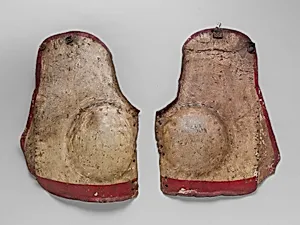
Step into the world of Renaissance chivalry with the *Peytral Plates*, a pair of protective chest guards for warhorses from the early 16th century. Likely crafted in Flemish or German workshops, these plates formed the front peytral of horse barding—elaborate armor ensembles that turned steeds into armored knights' noble companions. Displayed in the Metropolitan Museum of Art's Arms and Armor Department, they were generously gifted by Henry G. Keasbey in 1926. Crafted from leather reinforced with gesso—a plaster-like ground often used for gilding or painting—and accented with metal, these pieces blend functionality with artistry. The left plate measures 24½ x 18⅜ inches and weighs just over 2 pounds, while the right is slightly taller at 25⅜ x 15¾ inches and nearly 2 pounds. This lightweight construction suggests they may have been for parade or tournament use rather than battlefield combat, highlighting the era's advances in armor design amid the peak of European plate armor traditions. These rare survivors offer a glimpse into the cultural prestige of equestrian combat, where horses were as vital as riders. Their unknown artisan's skill in combining organic and metallic media underscores the intersection of craftsmanship and warfare in Renaissance Europe, inviting us to imagine thundering jousts and gleaming processions.