
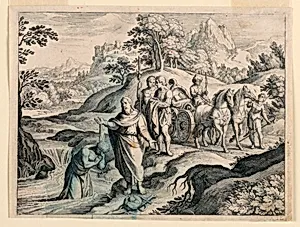
Philip Baptizing the Ethiopian
Classification
Department
Smithsonian Collection
Museum
Smithsonian American Art Museum
Credit
Smithsonian American Art Museum
Accession Number
1896-31-30
Rights
Public Domain
About this artwork
Research in Progress
Art Historical Context
Michel Lasne’s “Philip Baptizing the Ethiopian,” created around 1650, captures a pivotal moment from the New Testament in which the apostle Philip shares his faith with an Ethiopian court official and performs the first recorded baptism of a Gentile. As a French printmaker active during the reign of Louis XIII and into the early years of Louis XIV, Lasne specialized in clear, finely detailed reproductive prints that brought religious and historical subjects to a broad audience. Prints such as this one played an important cultural role in seventeenth-century Europe. Before photography, engravings and etchings allowed stories from scripture to circulate widely, serving both devotional and educational purposes in homes, churches, and schools. Lasne’s precise line work would have rendered the dramatic encounter with sensitivity, emphasizing the Ethiopian’s dignified presence and the sacramental act itself. Now preserved in the Smithsonian American Art Museum, the work invites visitors to consider how printmakers helped shape religious imagination across centuries and continents. Though catalogued as “Research in Progress,” its subject and the artist’s reputation already speak to the enduring power of visual storytelling in conveying themes of inclusion, conversion, and grace.