
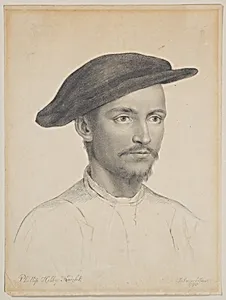
Philip Hobby Knight, after Holbein
Medium
Graphite
Dimensions
Sheet: 8 7/8 × 6 9/16 in. (22.5 × 16.7 cm)
Classification
Drawings
Department
Drawings and Prints
Museum
Metropolitan Museum of Art, New York, NY
Credit
Bequest of Harvey Salzman, 2020
Accession Number
2022.25.1
Rights
Public Domain
Tags
Art Historical Context
This delicate graphite drawing, titled *Philip Hobby Knight, afterbein* (1798), captures the dignified likeness of Sir Philip Hoby, a 16th-century English and knight who served under Henry VIII. The original portrait by Hans Holbein the Younger the masterful Tudor court painter renowned for his precise, psychologically penetrating style, dates to around 1540–43. Holbein's works, like this one, exemplify Renaissance portraiture's shift toward naturalistic detail and symbolic accessories—think fur-lined robes signifying status and a direct gaze conveying intellect and resolve. Hoby's image endures as a window into Elizabethan England's elite circles, where he navigated politics, poetry, and patronage. Created over two centuries later by Francesco Bartolozzi, a virtuoso Italian engraver active in London, with contributions from miniaturist John Smart Jr., this sheet faithfully reproduces Holbein's composition in graphite on paper (8 7/8 × 6 9/16 in.). Graphite's soft, tonal versatility allowed for subtle modeling of Hoby's features and textures, bridging old-master precision with 18th-century draftsmanship. As a "copy after," it reflects the era's fascination with Renaissance masters, serving artists, collectors, and engravers as a study aid. Now in the Metropolitan Museum of Art's Drawings and Prints collection (Bequest of Harvey Salzman, 2020), it highlights the enduring appeal of Holbein's legacy in fostering artistic dialogue across time.
About the Artist
Francesco Bartolozzi|Hans Holbein the Younger|John Smart Jr.|Sir Philip Hoby · 1727–1815
Francesco Bartolozzi (1727–1815) was an Italian engraver whose most productive period was spent in London, where he became the leading exponent of stipple engraving and a founding member of the Royal Academy. Born in Florence and trained first as a painter before turning to engraving in Venice, he established his reputation in Rome before being recruited by the English Royal Librarian Richard Dalt...