
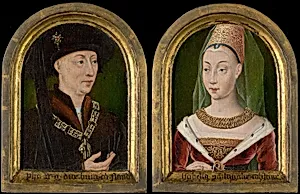
Philip the Good, Duke of Burgundy; Isabelle of Bourbon (?)
1510–30
Medium
Oil on panel
Dimensions
Each Frame: 21 × 16.2 cm (8 5/16 × 6 3/8 in.); Image: 16.5 × 12 cm (6 1/2 × 4 11/16 in.)
Classification
painting
Department
Painting and Sculpture of Europe
Museum
Art Institute of Chicago
Accession Number
39851
Rights
Public Domain
Art Historical Context
This pair of intimate oil-on-panel portraits, likely depicting Philip the Good, Duke of Burgundy, and possibly Isabelle of Bourbon, hails from the Flemish school around 1510–30. Crafted during the Northern Renaissance, these small works (each image just 16.5 × 12 cm) exemplify the era's mastery of oil painting, a technique pioneered by Flemish artists like Jan van Eyck. The allowed for luminous glazes, intricate details in clothing and jewelry, and a lifelike realism that brought historical figures vividly to life. Philip the Good (r. 1419–1467) was a pivotal ruler whose Burgundian court rivaled the splendor of kings, fostering arts, music, and chivalry amid the Hundred Years' War. These posthumous portraits, housed in the Art Institute of Chicago's Department of European Painting and Sculpture, may have served as personal devotional objects or paired pendants for a noble household. The uncertain identification of the female sitter underscores the challenges of attribution in early 16th-century Flemish art, yet their elegant profiles and richly textured attire capture the opulence of Valois Burgundy. Visitors will appreciate how these gems reflect Flanders' innovative portraiture, blending psychological depth with sumptuous detail in a format perfect for private contemplation.