
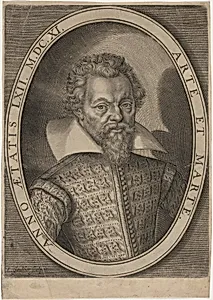
Philippe de Mornay (Du Plessis-Mornay)
1611
Medium
engraving
Dimensions
sheet: 27.1 × 19.2 cm (10 11/16 × 7 9/16 in.)
Classification
Department
CG-E
Museum
National Gallery of Art, Washington, D.C.
Credit
Rosenwald Collection
Accession Number
1950.14.925
Rights
Public Domain
Art Historical Context
In the National Gallery of Art's Rosenwald Collection, Léonard Gaultier's 1611 engraving *Philippe de MornayDu Plessis-Mornay)* captures the likeness of one of France's most influential Huguenot leaders. 27.1 × 19.2 cm, this intimate portrait exemplifies the era's fascination with disseminating powerful figures' images through print. Gaultier, a prolific French engraver active in the late 16th early 17th centuries, rendered Mornay—known as the "Pope of the Huguenots"—with fine lines that convey dignity and resolve, reflecting the turbulent religious landscape of post-Wars of Religion France. Philippe de Mornay (1549–1623) was a diplomat, theologian, and advisor to Henry IV, whose Edict of Nantes in 1598 granted limited tolerance to Protestants. This engraving, produced just after that fragile peace, immortalizes Mornay as a Protestant intellectual giant, whose writings defended Calvinism amid Catholic resurgence. Gaultier's technique—meticulous cross-hatching and intricate detailing on a copper plate—allowed for multiple impressions, making elite portraits accessible to a broader audience and underscoring printmaking's role in shaping public memory. As a classified print in the CG-E department, this work highlights engraving's artistic significance: a democratic medium bridging courtly portraiture and emerging print culture, bridging the Mannerist finesse of the 16th century with Baroque intensity. Visitors will appreciate how it freezes a pivotal moment in European religious history.
About the Artist
Léonard Gaultier · 1561–1641
Léonard Gaultier, a prolific French engraver born in Mainz around 1561, established himself as a prominent printmaker and publisher in Paris, where he died in 1641. Operating from addresses like "A l'Arche de Noé" on rue du Monceau-Saint-Gervais by 1585, he produced book illustrations, frontispieces, title pages, broadsides, almanacs, and standalone prints, often collaborating with publishers such...