
Philippe II, roi d'Espagne
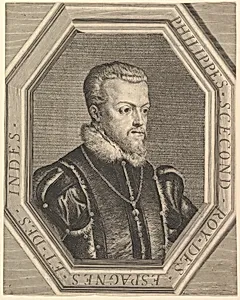
Medium
Etching
Dimensions
image: 11 1/8 x 8 7/8 in. (28.2 x 22.5 cm), trimmed to image (signatures cut off)
Classification
Prints
Department
Drawings and Prints
Museum
Metropolitan Museum of Art, New York, NY
Credit
Gift of Georgiana W. Sargent, in memory of John Osborne Sargent, 1924
Accession Number
24.63.2008
Rights
Public Domain
Tags
Art Historical Context
Behold *Philippe II, roi d'Espagne a striking etching that captures the regal presence of Spain's formidable 16th-century monarch, Philip II. Created by French engraver Jean Morin after an original portrait by the Renaissance master Titian (Tiano Vecellio), print exemplifies the era's fascination with reproductive printmaking. Titian, a leading Venetian painter known for his colors and psychological depth, portrayed Philip multiple times, emphasizing the king's stern gaze and authoritative demeanor—hallmarks of Habsburg portraiture. Etching, a technique involving acid to bite designs into metal plates, allowed Morin's meticulous lines to translate Titian's oil painting into an accessible print format. Measuring 11 1/8 x 8 7/8 inches and trimmed close to the image (with signatures lost), this example highlights the intimacy of prints as collectibles for Europe's elite. Philip II, ruler from 1556 to 1598, expanded Spanish influence across continents, funding the arts while navigating religious wars and the failed Armada invasion. Housed in the Metropolitan Museum of Art's Drawings and Prints department (gift of Georgiana W. Sargent, 1924), this work bridges painting and print traditions, offering visitors a window into Renaissance portraiture's power and the spread of royal imagery through innovative techniques.
About the Artist
Jean Morin|Titian (Tiziano Vecellio) · 1605–1650
Jean Morin (c. 1605–1650) was one of the most accomplished French engravers of the seventeenth century, a master of the portrait print whose work stands among the finest examples of French graphic art in its era. Little is known about his early life or training, though his technique suggests exposure to both French and Flemish engraving traditions, the latter being the dominant force in European p...