
Philippe Le Roy
1630/40
Medium
Etching and engraving in black on ivory laid paper
Dimensions
Image/plate: 24.2 × 15.5 cm (9 9/16 × 6 1/8 in.); Sheet: 25.4 × 16.4 cm (10 × 6 1/2 in.)
Classification
etching
Department
Prints and Drawings
Museum
Art Institute of Chicago
Accession Number
60035
Rights
Public Domain
About this artwork
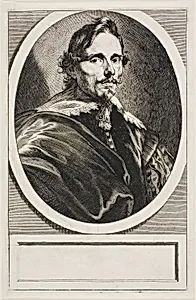
Anthony van Dyck produced stand-alone portraits of famous men as well as those in his Iconography; all of them went through multiple states of engraving. The first state, included only the sitter’s head. Another artist likely added the body and framing elements to this fourth state. The final state would include text describing the sitter and his coat of arms. Baron Philippe Le Roy was a Flemish diplomat who would help end the Thirty Years’ War in 1648; Van Dyck had already painted his portrait ...
Art Historical Context
Anthony van Dyck's *Philippe Le Roy*, created between 1630 and 1640, captures the elegance of Flemish Baroque portraiture in a striking etching and engraving on ivory laid paper. As one of Europe's leading portraitists, van Dyck—court painter to Charles I of England and a master of Antwerp's vibrant art scene—produced this work during his mature career, blending psychological depth with refined nobility. Measuring about 9½ by 6 inches, the print exemplifies the artist's shift toward printmaking to immortalize Europe's intellectual and cultural elite. This piece belongs to van Dyck's renowned *Iconographie* series, a groundbreaking collection of over 100 etched portraits of illustrious contemporaries, from artists and scholars to statesmen. Philippe Le Roy, likely a prominent figure of the era, is rendered with van Dyck's signature fluidity: etching's spontaneous, acid-etched lines convey expressive modeling, while engraving adds crisp, detailed precision for facial features and textures. Such mixed techniques made these prints affordable and widely distributable, disseminating van Dyck's vision across Europe. Housed in the Art Institute of Chicago's Prints and Drawings department, *Philippe Le Roy* highlights printmaking's role in democratizing portraiture during the 17th century, bridging painting's intimacy with engraving's reproducibility—a testament to van Dyck's innovative legacy.
About the Artist
Anthony van Dyck · 1599–1641
Sir Anthony van Dyck (1599-1641) was a Flemish Baroque artist who revolutionized portrait painting and became the most influential court painter in 17th-century England. Born in Antwerp as the seventh of twelve children to a prosperous silk merchant, van Dyck displayed extraordinary artistic talent from childhood. He trained under Hendrick van Balen before joining Peter Paul Rubens's workshop as a...