
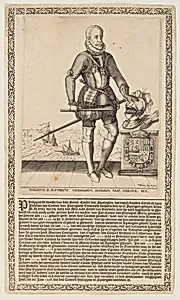
Phillip II, King of Spain
c. 1600
Medium
Engraving and letterpress, with woodcut borders, on ivory laid paper
Dimensions
Platemark: 18.6 × 14.5 cm (7 3/8 × 5 3/4 in.); sheet: 30.1 × 17.4 cm (11 7/8 × 6 7/8 in.)
Classification
Department
Prints and Drawings
Museum
Art Institute of Chicago
Accession Number
268309
Rights
Public Domain
Art Historical Context
This striking engraving by Dutch printmaker Christoffel van Sichem I captures Philip II, the powerful Habsburg ruler whose reign shaped the political landscape of late sixteenth-century Europe. Created around 1600, shortly after the king’s death in 1598, the portrait served as both a memorial and a means of circulating the monarch’s image across borders. Van Sichem, working in the tradition of Northern European printmaking, rendered the king with meticulous detail, emphasizing the solemn authority associated with one of the era’s most influential sovereigns. The work combines engraving for the central portrait with letterpress text and woodcut borders, a common yet sophisticated approach in early modern print production. This hybrid technique allowed for efficient reproduction while adding decorative elegance, making the image suitable for inclusion in books or as a standalone sheet. Such prints played a vital role in disseminating royal likenesses to a wider audience, bridging courtly representation and popular visual culture. Housed in the Art Institute of Chicago’s Department of Prints and Drawings, this impression on ivory laid paper highlights the enduring appeal of engraved portraits as historical documents. Its modest scale—roughly the size of a small book page—belies the far-reaching influence these images once held in shaping public perceptions of power.