
Photograp
1849–51
Medium
Salted paper print
Dimensions
Image: 5 7/16 × 7 1/8 in. (13.8 × 18.1 cm) Mount: 8 3/8 × 11 9/16 in. (21.2 × 29.4 cm)
Classification
Photographs
Department
Photographs
Museum
Metropolitan Museum of Art, New York, NY
Credit
Gilman Collection, Museum Purchase, 2005
Accession Number
2005.100.967.1 (5)
Rights
Public Domain
Art Historical Context
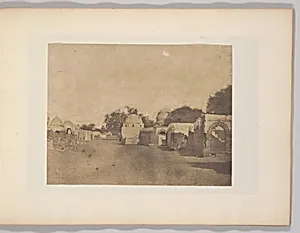
Maxime Du Camp's *Photograp* (1849–51) is a captivating salted paper print, measuring 5 7/16 × 7 1/8 inches, from the Metropolitan Museum of Art Gilman Collection. Created during the dawn of photography, this work exemplifies the medium's early potential to document distant wonders with unprecedented detail and intimacy. Du Camp, a writer and traveler, produced this image amid the 1840s photographic revolution, likely during his formative expeditions to the Middle East. The salted paper process—coating paper with salt and sensitizing it with silver nitrate—yielded soft, warm-toned prints from paper negatives, a technique pioneered by William Henry Fox Talbot's calotype. This allowed for subtle textures and atmospheric depth, bridging art and scientific record-keeping. As one of the earliest photographs in a major collection, *Photograp* highlights photography's role in preserving cultural heritage, inviting us to ponder the fragile beauty of history frozen in silver salts. A testament to innovation, it draws visitors into an era when cameras first rivaled the sketchbook.
About the Artist
Maxime Du Camp · 1822–present
Maxime Du Camp (1822–1894) was a pioneering French photographer and writer whose adventurous spirit and technical innovation bridged literature and visual art during the mid-19th century. Born in Paris on February 8, 1822, to a prosperous family—his father a successful surgeon—Du Camp received a solid bourgeois education at the Collège Bourbon (now Lycée Condorcet), where he cultivated interests i...