
Photograp
1849–51
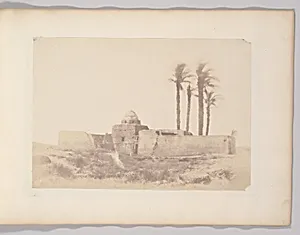
Medium
Salted paper print
Dimensions
Image: 5 7/8 × 8 7/16 in. (14.9 × 21.5 cm) Mount: 8 3/8 × 11 9/16 in. (21.2 × 29.4 cm)
Classification
Photographs
Department
Photographs
Museum
Metropolitan Museum of Art, New York, NY
Credit
Gilman Collection, Museum Purchase, 2005
Accession Number
2005.100.967.1 (13)
Rights
Public Domain
Art Historical Context
Maxime Du Camp's *Photograp* (1849–51) is a captivating salted paper print, an early photographic medium pioneered by William Henry Fox Talbot in the 1840s. Measuring just 5 7/8 × 8 7/16 inches, this intimate image exemplifies the nascent possibilities of photography during its experimental phase, when artists like Du Camp captured the world with paper negatives and chemical baths to produce soft, tonal prints. As a French writer and photographer, Du Camp traveled extensively in the late 1840s, documenting ancient sites with remarkable precision. Created amid the dawn of travel photography, this work from the Metropolitan Museum of Art's Gilman Collection highlights the era's blend of scientific curiosity and artistic vision. Salted paper prints, prized for their subtle gradations and matte surfaces, were fragile yet revolutionary, bridging painting and reality. Part of the Met's Photographs department, acquired through a 2005 museum purchase, this piece invites visitors to ponder photography's role in preserving history. Du Camp's efforts helped popularize the medium, influencing generations by freezing fleeting moments in time.
About the Artist
Maxime Du Camp · 1822–present
Maxime Du Camp (1822–1894) was a pioneering French photographer and writer whose adventurous spirit and technical innovation bridged literature and visual art during the mid-19th century. Born in Paris on February 8, 1822, to a prosperous family—his father a successful surgeon—Du Camp received a solid bourgeois education at the Collège Bourbon (now Lycée Condorcet), where he cultivated interests i...