
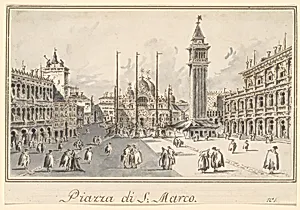
Piazza San Marco, Looking toward the Basilica
ca. 1804–28
Medium
Pen and brown ink, gray wash
Dimensions
4 15/16 x 8 3/8 in. (12.5 x 21.2 cm)
Classification
Drawings
Department
Robert Lehman Collection
Museum
Metropolitan Museum of Art, New York, NY
Credit
Robert Lehman Collection, 1975
Accession Number
1975.1.345
Rights
Public Domain
Tags
Art Historical Context
Giacomo Guardi’s *Piazza San Marco, Looking toward the Basilica* captures one of Venice’s most iconic public spaces in a delicate pen-and-ink drawing heightened with gray wash. Created between 1804 and 1828, the small sheet (roughly 5 by 8 inches) presents a sweeping view across the bustling square toward the ornate façade of San Marco. Guardi, son of the celebrated view painter Francesco Guardi, continued the family tradition of recording the city’s architecture and atmosphere for an audience of travelers and collectors. Executed with quick, confident strokes and subtle tonal washes, the drawing demonstrates the economical yet evocative technique typical of Venetian vedute. The medium allows Guardi to suggest the play of light on stone and the lively presence of figures without overworking the surface, giving the scene an immediacy that feels both documentary and poetic. Such works were prized by Grand Tour visitors eager to carry home portable souvenirs of the city’s splendor. Acquired by the Metropolitan Museum through the Robert Lehman Collection in 1975, this drawing preserves a moment when Venice, newly under Austrian rule, remained a magnet for artists and tourists. It offers today’s viewers an intimate glimpse of how the piazza was experienced in the early nineteenth century—its architecture, crowds, and enduring allure rendered with quiet precision.
About the Artist
Giacomo Guardi · 1764–1835
Giacomo Guardi (1764–1835) was a Venetian painter who worked in the long shadow of his celebrated father, Francesco Guardi, one of the greatest vedutisti — view painters — of the eighteenth century. Born into one of Venice's most prominent artistic families, Giacomo received his training directly from his father, absorbing both the technical methods and the characteristic style that had made Franc...