
Piece
Unknown Artist
early 18th century
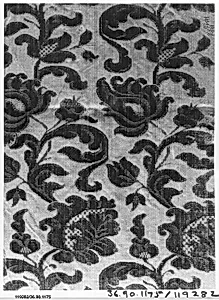
Medium
Silk
Dimensions
L. 22 1/4 x W. 11 inches (56.5 x 27.9 cm)
Classification
Textiles-Velvets
Culture
possibly French
Department
European Sculpture and Decorative Arts
Museum
Metropolitan Museum of Art, New York, NY
Credit
Gift of The United Piece Dye Works, 1936
Accession Number
36.90.1175
Rights
Public Domain
Tags
Art Historical Context
This exquisite silk velvet fragment, simply titled *Piece*, hails from the early 18th century and the opulent textile arts of possibly French origin. Measuring 22¼ x 11 inches, it features delicate motifs of flowers and leaves, rendered with the rich pile characteristic of velvet weaving. Velvet, prized for its luxurious sheen and tactile depth, was a hallmark of European decorative arts during this era, often adorning royal furnishings, ecclesiastical vestments, and elite fashion. In the lavish courts of Louis XIV and the dawn of Louis XV's reign, such textiles showcased advanced loom techniques like cut-pile weaving, where silk threads were sheared to create a soft, velvety surface that caught the light dramatically. Floral patterns like those here drew from nature's abundance, symbolizing prosperity and the Baroque taste for exuberance transitioning toward Rococo elegance. Though the artist remains unknown, this piece reflects the skilled craftsmanship of anonymous workshops that supplied Europe's aristocracy. Now in the Metropolitan Museum of Art's Department of European Sculpture and Decorative Arts—gifted by The United Piece Dye Works in 1936—this fragment offers a tangible glimpse into 18th-century luxury. It invites visitors to appreciate how textiles were not mere fabric, but woven narratives of cultural splendor and technical mastery.