
Piece
Unknown Artist
18th–19th century
Medium
Silk
Dimensions
5 1/4 x 1 3/4 in. (13.34 x 4.45 cm)
Classification
Textiles-Woven
Culture & Period
Japan · Edo (1615–1868)
Department
Asian Art
Museum
Metropolitan Museum of Art, New York, NY
Credit
Gift of Mr. and Mrs. H. O. Havemeyer, 1896
Accession Number
96.14.457
Rights
Public Domain
Art Historical Context
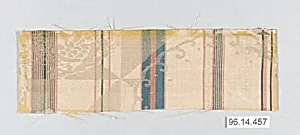
This delicate silk textile fragment, known simply as *Piece*, hails from Japan's Edo period (16151868), a time of remarkable peace, prosperity, and cultural flourishing under the Tokugawa shogunate. Spanning the 18th to 19th centuries, Edo era saw urban centers like Edo (modern Tokyo) buzz with artisans perfecting crafts for everyday life and elite fashion. Woven textiles like this one were central to Japanese society, adorning kimonos, obi sashes, and furnishings that reflected social status and seasonal motifs. Crafted from fine silk—a material Japan mastered through centuries of sericulture and advanced loom techniques—this 5¼ x 1¾-inch piece exemplifies the precision of Edo-era weaving. Artisans employed intricate patterning methods, often creating subtle textures and designs without dyes alone, highlighting silk's natural luster and durability. Such small fragments were common as samples traded internationally or preserved from larger garments, offering glimpses into a world where textiles blended utility with artistry. Generously gifted to the Metropolitan Museum of Art in 1896 by Mr. and Mrs. H. O. Havemeyer, avid collectors of Asian treasures, this work invites us to appreciate the unsung mastery of anonymous Japanese weavers. In the Asian Art department, it stands as a testament to Edo Japan's innovative spirit and enduring textile legacy.