
Piece
Unknown Artist
18th–19th century
Medium
Silk
Dimensions
3 1/2 x 4 in. (8.89 x 10.16 cm)
Classification
Textiles-Woven
Culture & Period
Japan · Edo period (1615–1868)
Department
Asian Art
Museum
Metropolitan Museum of Art, New York, NY
Credit
Gift of Mr. and Mrs. H. O. Havemeyer, 1896
Accession Number
96.14.650
Rights
Public Domain
Art Historical Context
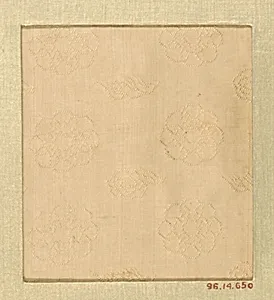
This exquisite silk textile fragment, dating to the 18th–19th during Japan's Edo period (16151868), offers a glimpse into the refined artistry of the era. The Edo period was a time of relative peace and prosperity under the Tokugawa shogunate, fostering vibrant urban culture, including masterful textile production. Woven silks like this small piece (just 3½ x 4 inches) were prized for clothing, furnishings, and ceremonial garments, reflecting social status and aesthetic sophistication. Crafted as a woven textile, it the intricate loom techniques developed in weaving centers like Kyoto's Nishijin district. Silk threads were meticulously interlaced to create durable, lustrous fabrics often featuring subtle patterns or motifs inspired by nature, seasons, or daily life—hallmarks of Edo-era design that blended functionality with beauty. Though the exact design details are not specified, such pieces highlight Japan's advanced dyeing and weaving innovations, which influenced global textiles. Generously gifted to the Metropolitan Museum of Art in 1896 by Mr. and Mrs. H. O. Havemeyer, prominent collectors of Asian art, this "Piece" invites visitors to appreciate the delicate scale and cultural depth of Edo craftsmanship, a testament to Japan's enduring textile legacy.