
Piece
Unknown Artist
18th–19th century
Medium
Silk
Dimensions
3 x 2 3/4 in. (7.62 x 6.99 cm)
Classification
Textiles-Woven
Culture & Period
Japan · Edo (1615–1868) or Meiji period (1868–1912)
Department
Asian Art
Museum
Metropolitan Museum of Art, New York, NY
Credit
Gift of Mr. and Mrs. H. O. Havemeyer, 1896
Accession Number
96.14.700
Rights
Public Domain
Art Historical Context
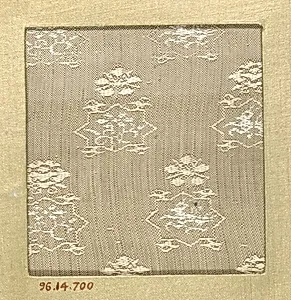
This exquisite silk textile fragment, titled simply *Piece*, hails from Japan during the late Edo period (1615–1868) or early Meiji era (1868–1912 Measuring just 3 x 2¾ inches, it exemplifies the masterful weaving techniques of Japanese artisans, who transformed fine silk threads into intricate fabrics for garments like kimonos and obiashes. Donated to the Metropolitan Museum of Art 1896 by Mr. and Mrs. H. O. Havemeyer, reflects the growing Western fascination with Japanese art during the late 19th century. Woven textiles were a cornerstone of Edo and Meiji craftsmanship, blending functionality with aesthetic beauty. Artisans employed complex looms to create patterns through techniques such as supplementary weft weaving or ikat dyeing, where threads were resist-dyed before weaving for subtle, blurred motifs often inspired by nature, theater, or daily life. Silk, prized for its luster and durability, symbolized refinement in a society where clothing conveyed social status. Though its exact design remains unrecorded here, this small *Piece* captures the cultural zenith of Japanese textile arts—a time when isolationist Edo fostered innovation, and Meiji opened doors to global influence. Visitors can appreciate how such miniatures preserve the ingenuity of anonymous makers, offering a tactile window into Japan's elegant material heritage.