
Piece
Unknown Artist
18th–19th century
Medium
Silk
Dimensions
8 x 5 1/4 in. (20.32 x 13.34 cm)
Classification
Textiles-Woven
Culture
Japan
Department
Asian Art
Museum
Metropolitan Museum of Art, New York, NY
Credit
Gift of Mr. and Mrs. H. O. Havemeyer, 1896
Accession Number
96.14.775
Rights
Public Domain
Art Historical Context
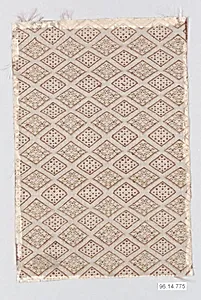
This exquisite silk textile fragment, known simply as *Piece*, hails from Japan during the 18th–19th, a golden era for the country's renowned weaving traditions. Measuring just 8 x 5¼ inches (20.32 x 13.34 cm), its compact size suggests it may have been a sample, patch, or remnant from a larger garment like a kimono or obi. Crafted in the Asian Art department's Textiles-Woven classification at Metropolitan Museum of Art, exemplifies the meticulous artistry of Japanese silk production, gifted in 1896 by collectors Mr. and Mrs. H. O. Havemeyer. Silk weaving reached extraordinary heights in Edo-period (1603–1868) and early Meiji-era Japan, where artisans employed complex Jacquard-like looms and intricate patterning techniques to create luxurious fabrics. These textiles were not merely functional but symbols of status, often featuring motifs inspired by nature, seasons, or folklore—though this piece's specific design remains a tantalizing mystery due to its unknown details. The lustrous silk medium highlights Japan's mastery of sericulture, transforming fine threads into shimmering masterpieces that influenced global fashion. As part of the Met's vast Asian collection, this unassuming fragment invites us to appreciate the unsung labor behind Japan's textile legacy, where every weave told a story of innovation and cultural pride. A closer look reveals the enduring elegance of a craft that bridged centuries.