
Piece
Unknown Artist
18th–19th century
Medium
Silk
Dimensions
4 x 3 1/4 in. (10.16 x 8.26 cm)
Classification
Textiles-Woven
Culture
Japan
Department
Asian Art
Museum
Metropolitan Museum of Art, New York, NY
Credit
Gift of Mr. and Mrs. H. O. Havemeyer, 1896
Accession Number
96.14.897
Rights
Public Domain
Art Historical Context
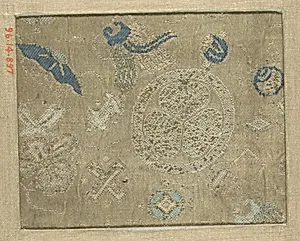
This exquisite silk textile fragment, titled simply *Piece*, hails from Japan during the 18th–19th, a time when the country’s weaving traditions reached extraordinary heights. Measuring just 4 x 3¼ inches (10.16 x 8.26 cm), this small woven artwork exemplifies the precision and artistry of Japanese textile production, likely from the Edo period (1615–1868) or Meiji era. Crafted by an unknown artist it belongs to the Metropolitan of Art’s Asian Art, generously gifted by Mr and Mrs. H.. Havemeyer in 1896—a testament to early Western fascination with Japanese craftsmanship. Silk weaving was a cornerstone of Japanese culture, with regions like Kyoto’s Nishijin district renowned for intricate looms that produced luxurious fabrics for kimonos, obi sashes, and ceremonial garments. The use of fine silk here highlights advanced techniques such as jacquard-like patterning or supplementary wefts, which allowed for complex designs despite the modest scale. These textiles were not merely functional; they embodied aesthetic ideals like *wabi-sabi*—celebrating imperfection and transience—while serving as status symbols in a society stratified by samurai, merchants, and artisans. Though its exact design remains unrecorded in this context, this fragment invites us to appreciate the labor-intensive process behind Japan’s silk legacy, which fueled global trade and influenced modern fashion. A quiet survivor of history, it reminds visitors of the delicate beauty woven into everyday life centuries ago.