
Piece
Unknown Artist
18th–19th century
Medium
Silk
Dimensions
4 1/2 x 7 in. (11.43 x 17.78 cm)
Classification
Textiles-Woven
Culture
Japan
Department
Asian Art
Museum
Metropolitan Museum of Art, New York, NY
Credit
Gift of Mr. and Mrs. H. O. Havemeyer, 1896
Accession Number
96.14.1532
Rights
Public Domain
Tags
Art Historical Context
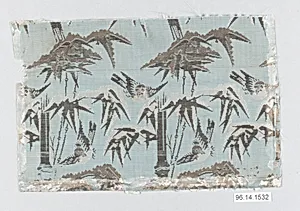
This delicate woven silk textile, created in Japan during the 18th–19th centuries, captures the refined elegance of nature through its motifs of birds perched among bamboo. Measuring just 4½ by 7 inches, the small scale suggests it may have served as a fragment from a larger garment, such as a kimono or obi, or perhaps a decorative panel. As a product of Japanese textile, it reflects the high level of craftsmanship in silk weaving during the Edo period, when intricate patterns were developed to adorn clothing and furnishings for the merchant and samurai classes. The imagery of birds and bamboo carries deep cultural resonance in Japanese art, symbolizing resilience, longevity, and harmony with the natural world. Bamboo’s flexible strength and the birds’ graceful presence evoke seasonal themes and poetic ideals often celebrated in literature and visual arts of the time. The unknown artist employed sophisticated weaving techniques to create subtle textures and contrasts, demonstrating how even modest textiles could convey profound aesthetic and symbolic meaning. Donated to the Metropolitan Museum of Art in 1896 by the prominent collectors Mr. and Mrs. H. O. Havemeyer, this piece offers a glimpse into Japan’s rich textile heritage and its enduring influence on global appreciation for Asian art.