
Piece
Unknown Artist
18th–19th century
Medium
Silk
Dimensions
9 x 6 3/4 in. (22.86 x 17.15 cm)
Classification
Textiles-Woven
Culture
Japan
Department
Asian Art
Museum
Metropolitan Museum of Art, New York, NY
Credit
Gift of Mr. and Mrs. H. O. Havemeyer, 1896
Accession Number
96.14.1852
Rights
Public Domain
Tags
Art Historical Context
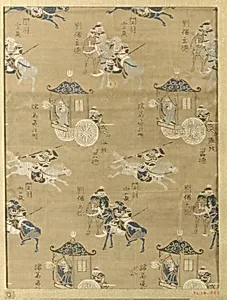
This exquisite silk textile fragment, titled simply *Piece*, hails from Japan during the 18th–19th, a time when Edo-period craftsmanship flourished alongside the dawn of modernization in the Meiji era.oven with remarkable precision, its small scale—measuring just 9 x 6¾ inches—likely served as part of a larger garment,, or decorative hanging. The motifs of carriages and horses evoke scenes of travel, processions, or elite transport, symbols of status and mobility in feudal Japan, where such imagery often appeared in textiles for samurai or merchants. Japanese woven silks like this exemplify *tsuzure-ori* or figured-weave techniques, where intricate patterns are created directly on the loom through supplementary wefts, showcasing the weaver's skill without relying on dyes or embroidery. Silk, prized for its luster and durability, was a luxury material, traded along historic routes and celebrated in ukiyo-e prints. This piece entered the Metropolitan Museum of Art in 1896 as a gift from Mr. and Mrs. H. O. Havemeyer, avid collectors who helped build the museum's renowned Asian Art collection. Though the artist remains unknown, the fragment's vibrant depiction captures Japan's textile artistry at its peak, inviting us to imagine the bustling roads and elegant equipages it portrays—a window into a world of refined beauty and cultural pride.