
Piece
Unknown Artist
18th–19th century
Medium
Silk
Dimensions
2 1/2 x 4 in. (6.35 x 10.16 cm)
Classification
Textiles-Woven
Culture
Japan
Department
Asian Art
Museum
Metropolitan Museum of Art, New York, NY
Credit
Gift of Mr. and Mrs. H. O. Havemeyer, 1896
Accession Number
96.14.1960
Rights
Public Domain
Art Historical Context
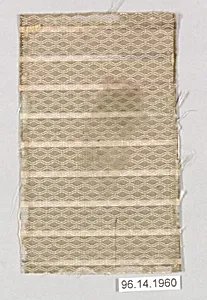
This exquisite silk textile fragment, simply titled *Piece*, hails from Japan during the 18th–19th, a golden era for the country's renowned weaving traditions. Measuring just 2½ x 4 inches, this diminutive woven artwork exemplifies the meticulous craftsmanship of Edo-period (1603–1868) and early Me-era (1868–1912), who transformed raw silk into luxurious fabrics for garments, obi sashes, and ceremonial items. Though the artist remains unknown, such pieces were often produced in specialized textile centers like Nishijin in Kyoto, where weavers innovated complex patterns using looms that interwove dyed threads for subtle textures and motifs. Silk, Japan's prized medium, held profound cultural significance as a symbol of refinement and social status. Woven textiles like this one showcased advanced techniques, including supplementary weft patterning or ikat dyeing, which created intricate designs reflecting nature, seasons, or auspicious symbols—though specifics here are inferred from the era's conventions. Prized by collectors worldwide, this fragment entered the Metropolitan Museum of Art in 1896 as a gift from Mr. and Mrs. H. O. Havemeyer, avid patrons whose acquisitions enriched our understanding of Asian artistry. Today, it invites us to marvel at the patience behind each thread, a tiny window into Japan's enduring legacy of beauty in the everyday.