
Piece
Unknown Artist
18th–19th century
Medium
Silk
Dimensions
5 1/2 x 5 in. (13.97 x 12.70 cm)
Classification
Textiles-Woven
Culture
Japan
Department
Asian Art
Museum
Metropolitan Museum of Art, New York, NY
Credit
Gift of Mr. and Mrs. H. O. Havemeyer, 1896
Accession Number
96.14.2054
Rights
Public Domain
Art Historical Context
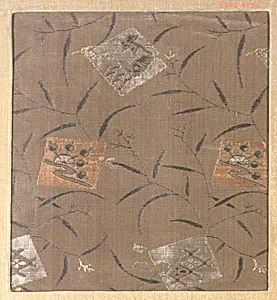
This exquisite silk textile fragment, titled *Piece*, hails from Japan during the 18th–19th, a time when the country’s weaving traditions reached extraordinary heights of refinement. Measuring just 5½ x 5 inches, small woven square exemplifies the meticulous craftsmanship of Japanese artisans, who transformed raw silk into luxurious fabrics for kimonos, obi sashes, and ceremonial garments. As a woven textile in the Asian Art collection of the Metropolitan Museum of Art it showcases the era’s mastery of the loom, where threads were interlaced to create intricate patterns and textures prized for their durability and sheen. Silk weaving held profound cultural significance in Edo-period (1603–1868) and early Meiji Japan (1868–1912), symbolizing elegance, status, and technical innovation. Artisans employed sophisticated techniques like plain weave or twill variations, often dyeing yarns beforehand to produce subtle motifs inspired by nature, seasons, or daily life. Though the artist remains unknown, such pieces reflect the anonymous brilliance of guild-trained weavers, whose work fueled Japan’s textile trade and influenced global fashion. Generously gifted to the Met in 1896 by Mr. and Mrs. H. O. Havemeyer, prominent collectors of Asian and Impressionist art, this fragment invites us to appreciate the tactile poetry of silk—soft yet resilient, a whisper of Japan’s artistic heritage preserved for modern eyes.