
Piece
Unknown Artist
18th century
Medium
Silk / Compound weave
Dimensions
1 1/4 × 5 7/8 in. (3.2 × 14.9 cm)
Classification
Textiles-Woven
Culture & Period
China · Qing dynasty (1644–1911)
Department
Asian Art
Museum
Metropolitan Museum of Art, New York, NY
Credit
Gift of Kihei Hattori, in memory of his father, Kihei Hattori, 1920
Accession Number
20.148.396
Rights
Public Domain
Art Historical Context
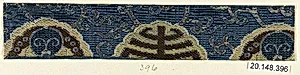
This exquisite silk textile fragment, titled simply *Piece*, hails from 18th-century China during the Qing dynasty (164–1911), a age for imperial craftsmanship and luxury goods. Measuring just 1¼ × 5⅞ inches (3.2 × 14.9 cm), this diminutive woven sample exemplifies the finesse of Chinese silk production, which was a cornerstone of the empire's economy and cultural prestige. Donated to the Metropolitan Museum of Art in 1920 by Kihei Hattori in memory of his father, it now resides in the Asian Art department, offering a tangible glimpse into everyday opulence. Crafted using a compound weave technique—a sophisticated method that interlaces multiple sets of warp and weft yarns to create intricate patterns in a single layer—this piece highlights the technical virtuosity of Qing weavers. Silk, revered as "the fabric of emperors," was woven on specialized looms capable of producing richly textured surfaces ideal for robes, hangings, and ceremonial objects. Though the exact design remains unspecified, such textiles often featured motifs symbolizing harmony, prosperity, and longevity, reflecting Confucian ideals and imperial tastes. In the context of Qing material culture, fragments like this underscore silk's role beyond mere utility: it was a status symbol, a trade commodity along ancient routes, and an artistic medium rivaling painting or porcelain. Visitors can appreciate how this unassuming "piece" encapsulates centuries of innovation, inviting us to marvel at the delicate interplay of thread and history.