
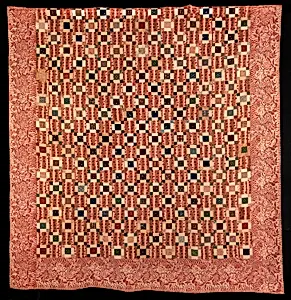
Pieced Quilt (Nine Patch Variation)
Medium
Decorative Arts-Fiber
Classification
Decorative Arts-Fiber
Department
Smithsonian Collection
Museum
Smithsonian American Art Museum
Credit
Smithsonian American Art Museum, Gift of Patricia S. Smith
Accession Number
1998.149.16
Rights
Public Domain
Art Historical Context
Step into the cozy world of 19th-century American domestic arts with *Pieced Quilt (Nine Patch Variation)*, crafted around 1830 by R. W. V., an enigmatic active from the late 18th to 19th century. fiber artwork exemplifies the piecing technique, where small scraps of fabric are meticulously sewn into repeating blocks—a hallmark of quilt-making that transformed everyday textiles into vibrant, functional masterpieces. The Nine Patch variation features a classic grid of nine squares per block, often arranged in colorful alternating patterns, showcasing the quilter's skill in geometry and color harmony. In the early 1830s, amid America's growing frontier spirit, quilts like this served dual purposes: warming beds through harsh winters and preserving family stories via salvaged fabrics from worn clothing or cherished garments. R. W. V.'s creation reflects the ingenuity of anonymous women artisans, whose handiwork elevated folk craft to high art. As a prime example of decorative fiber arts, it highlights resourcefulness and creativity in pre-industrial households. Now treasured in the Smithsonian American Art Museum—thanks to the gift of Patricia S. Smith—this quilt invites us to appreciate the unsung threads of American history, where utility met beauty in every stitch.