
Pietà
Medium
Engraving; second state of two
Dimensions
sheet: 7 1/8 x 5 3/16 in. (18.1 x 13.1 cm)
Classification
Prints
Department
Drawings and Prints
Museum
Metropolitan Museum of Art, New York, NY
Credit
Harris Brisbane Dick Fund, 1917
Accession Number
17.3.493
Rights
Public Domain
Tags
Art Historical Context
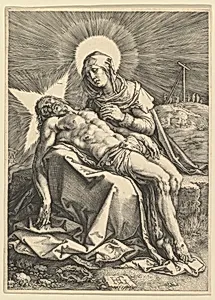
Hendrick Goltzius created this intimate Pietà in 1596 as an engraving, capturing the profound sorrow of the Virgin Mary as she cradles the lifeless body of Christ. The composition draws viewers into a quiet moment of grief, emphasizing the tender relationship between mother and son through their close embrace and the Virgin’s bowed head. Produced during the late Renaissance, when religious subjects remained central to European art, the print reflects the enduring power of this traditional theme to evoke empathy and devotion. As a second-state engraving, the work showcases the medium’s remarkable capacity for fine detail within a small sheet measuring just over seven by five inches. Engraving allowed artists like Goltzius to achieve delicate lines and subtle tonal contrasts, making the figures’ expressions and drapery appear almost sculptural. Such prints were widely circulated, enabling devotional images to reach audiences beyond churches and palaces. Today housed in the Metropolitan Museum of Art’s collection of drawings and prints, this Pietà exemplifies how printmaking democratized religious art in the sixteenth century while preserving deeply human emotions of loss and compassion for generations of viewers.
About the Artist
Hendrick Goltzius · 1558–1617
Hendrick Goltzius (1558–1617) was the most celebrated engraver of the Northern Renaissance and a pivotal figure in Dutch Mannerism. Born near the German-Dutch border, Goltzius transformed printmaking into a virtuoso art form through his revolutionary 'swelling line' technique, where the burin was manipulated to create lines of varying thickness that produced unprecedented tonal effects and three-d...