
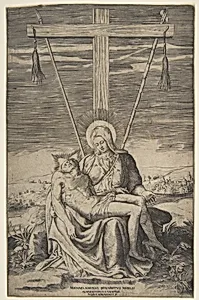
Pieta under the Cross of Golgatha
Medium
Engraving
Dimensions
sheet: 10 7/8 x 7 3/16 in. (27.6 x 18.3 cm)
Classification
Prints
Department
Drawings and Prints
Museum
Metropolitan Museum of Art, New York, NY
Credit
The Elisha Whittelsey Collection, The Elisha Whittelsey Fund, 1959
Accession Number
59.595.3
Rights
Public Domain
Tags
Art Historical Context
This engraving, created in 1547 by Giulio Bonasone after a design by Michelangelo Buonarroti, captures the poignant Pietà scene at the foot of the Cross on Golgotha. The composition centers on the Virgin Mary cradling the body of Christ, a timeless theme of maternal sorrow and redemption drawn from Christian tradition. Bonasone, an accomplished Italian printmaker of the Renaissance, specialized in reproductive engravings that translated the works of master artists like Michelangelo into accessible printed form. Michelangelo’s influence is evident in the dramatic figural poses and emotional intensity, hallmarks of his High Renaissance style. Though best known for monumental sculptures and frescoes, his designs were frequently disseminated through prints, allowing broader audiences to engage with his vision. The engraving medium itself played a vital cultural role in the 16th century, enabling precise line work and tonal depth that conveyed both sculptural volume and spiritual gravity. Housed in the Metropolitan Museum of Art’s collection of drawings and prints, this sheet measuring roughly 11 by 7 inches exemplifies how reproductive engravings preserved and popularized iconic religious imagery during the Renaissance.
About the Artist
Giulio Bonasone|Michelangelo Buonarroti · 1500–1600
Comment on works: History; Mythology