
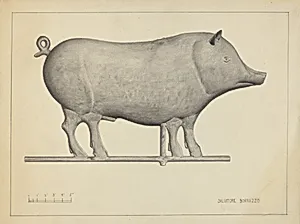
Pig Weather Vane
c. 1937
Medium
graphite on paper
Dimensions
overall: 21.7 x 29 cm (8 9/16 x 11 7/16 in.) Original IAD Object: 30" long; 19" high
Classification
Index of American Design
Department
CG-W
Museum
National Gallery of Art, Washington, D.C.
Credit
Index of American Design
Accession Number
1943.8.16210
Rights
Public Domain
Art Historical Context
In the whimsical *Pig Weather Vane*, Salvatore Borrazzo captures the charm of American folk art through a precise graphite drawing on paper, created around 1937. Measuring 21.7 x 29 cm, this work meticulously renders a sheet-metal weather vane shaped like a plump pig, originally 30 inches long and 19 inches high. The pig's playful form, with its curly tail and alert ears, exemplifies the humorous animal motifs popular in 19th- and early 20th-century American vernacular design, often perched atop barns and homes to indicate wind direction while adding a touch of personality to rural landscapes. This drawing is part of the *Index of American Design* (IAD), a landmark Federal Art Project under the Works Progress Administration (WPA) during the Great Depression. Launched in 1935, the IAD employed artists like Borrazzo to document thousands of everyday objects, preserving the nation's cultural heritage through detailed, watercolor and graphite renderings. Housed in the National Gallery of Art's collection, it highlights how folk weather vanes blended functionality with artistry, reflecting regional craftsmanship and the ingenuity of American makers. Borrazzo's technique—fine graphite lines shading subtle contours and textures—brings the three-dimensional original to life on a flat surface, making this accessible study a testament to the IAD's mission: celebrating the democratic spirit of design in everyday life. Visitors will delight in its folksy appeal and historical snapshot of pre-industrial America.
About the Artist
Salvatore Borrazzo · 1916–1964
Salvatore Borrazzo is an artist whose biographical details are only partially recoverable from the available historical record. His dates, precise nationality, training, and the full extent of his artistic production have not been firmly established in the scholarly sources currently accessible, placing him among the many artists whose names appear in collection and exhibition records but whose li...